

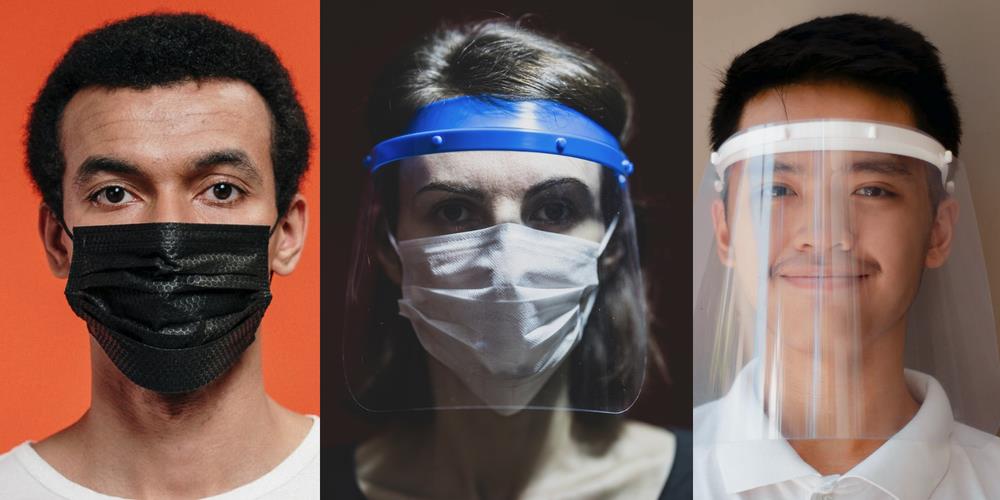
Employees are required to wear face coverings due to the nature of their work. An employee has asked if they can use a face shield rather than a face covering. Is this allowed?
Unless your employee is exempt from wearing a face covering, a face shield is not a suitable alternative.
Face coverings are mainly intended to protect others and not the wearer. When used correctly, they cover the nose and mouth, which are the main sources of transmitting coronavirus.
There are many circumstances where employees may be required to use face coverings, either through legislative requirements, as part of an organisation’s Covid secure risk control measures or on a voluntary basis.
Guidance from the UK Government website states that “a face visor or shield may be worn in addition to a face covering but not instead of one. This is because face visors or shields do not adequately cover the nose and mouth”. The Scottish, Welsh and Northern Ireland Governments, in their respective Covid guidance, have all said that visors/shields are not considered face coverings as they do not provide adequate protection alone.
Guidance does recommend the use of clear visors together with face masks for those working in close contact/close proximity of others such as hairdressing.
The US Center for Disease Control and Prevention (CDC) clarifies this further, stating that “face shields and goggles are primarily used to protect the eyes of the person wearing it” and that “face shields are not as effective at protecting people around you from your respiratory droplets. Face shields have large gaps below and alongside the face, where your respiratory droplets may escape and reach others around you”.
If an employee is exempt from wearing a face covering (eg on medical grounds) they may consider wearing a visor, as this may offer some protection against transmission of the virus to others rather than no protection at all.
If this option is to be considered, it is recommended that users:
-
choose a face shield that wraps around the sides of the face and extends below the chin or a hooded face shield, as data suggests these types of face shields are better at preventing spray of respiratory droplets
-
wash their hands after removing the face shield and avoid touching their eyes, nose and mouth when removing the face shield
-
clean and disinfect reusable face shields according to the manufacturer’s instructions
-
if using a disposable face shield, wear it once and throw it away according to the manufacturer’s instructions.
Last reviewed 23 February 2021