

Can occupational exoskeletons combat work-related MSDs?
This article by Tina Weadick is is reproduced courtesy of Health & Safety Review
Exoskeletons and their potential to reduce work-related musculoskeletal disorders (MSDs) are the subjects of a new discussion paper from the European Agency for Safety and Health at Work (EU-OSHA).
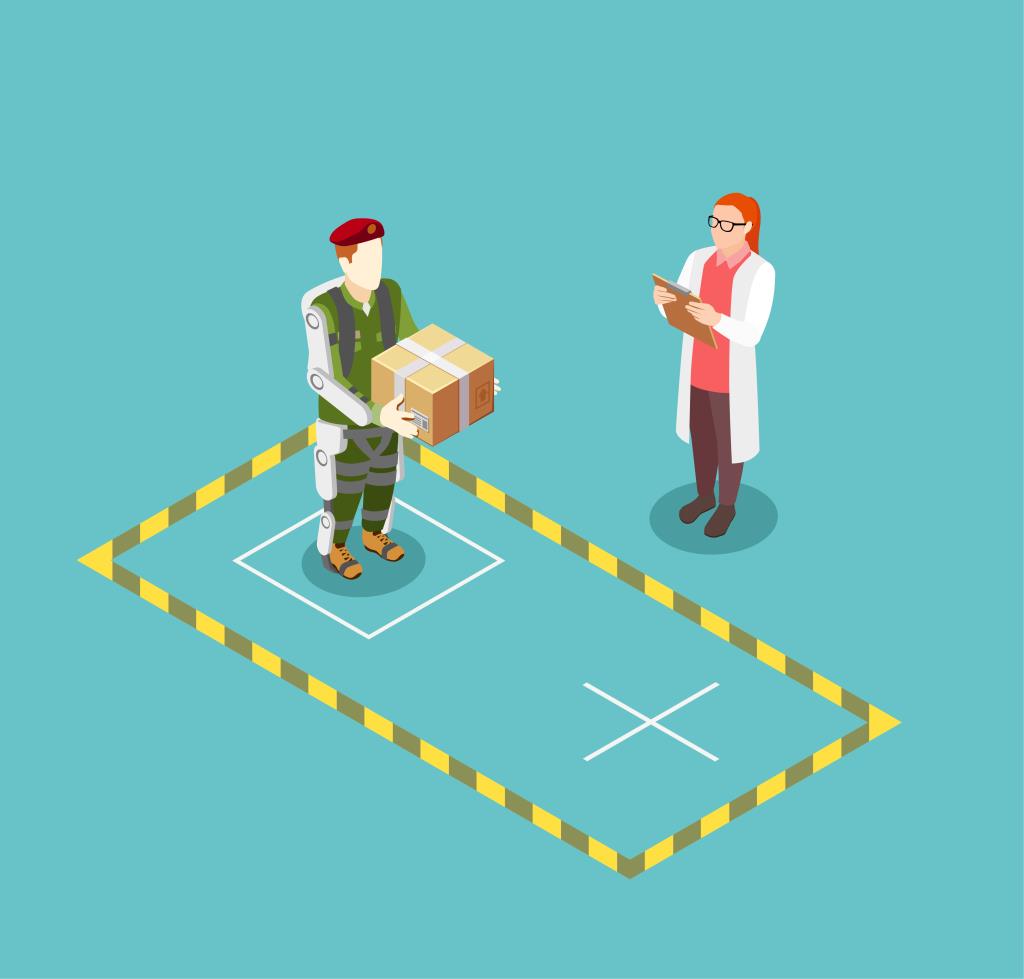
Occupational exoskeletons are wearable assistive devices that can reduce physical strain caused by heavy lifting and similar tasks, offering a solution where other technical, organisational or ergonomic design measures are not enough or not practicable. Nevertheless, their use remains limited.
The EU-OSHA paper, which was developed as part of an agreement with Italian researchers working on MSDs and collaborative exoskeletons, aims to define the state of the art of this technology and illustrate what needs to be done to maximise user benefits and minimise potential negative impacts, through a human-centred design (HCD) approach.
The paper differentiates between active and passive exoskeletons (the former use actuators, or mechanical drive components, while the latter use the restoring forces of springs, dampers, etc. to support human movement), robots and robotic devices, and wearable robots (which provide an assistive force to supplement or augment personal capabilities) and lumbar-support robots (which reduce the load on the lower back through an assistive force or torque).
In relation to occupational exoskeletons – which can be classified into lower-, upper- and full-body versions – the paper notes that the landscape has “expanded substantially in recent years”. However, there are specific safety issues and risk scenarios to be taken into account relating to their long-term use.
For example, while they can present an opportunity to reduce muscular, joint, ligament and bone stress at work, they may result in the redistribution of stress to other body regions. They can also be uncomfortable to wear, which hinders user acceptance, according to the paper. It concludes that the HCD approach can be a tool to guarantee that these systems respond more precisely to the real needs of users and thus enter into more widespread use. To download the discussion paper, visit: https://bit.ly/33W3A5r
“image: Freepik.com”
_________________________________________________________________________________

This article is reproduced courtesy of Health & Safety Review.
Find out further information about subscription to the HSR magazine.